
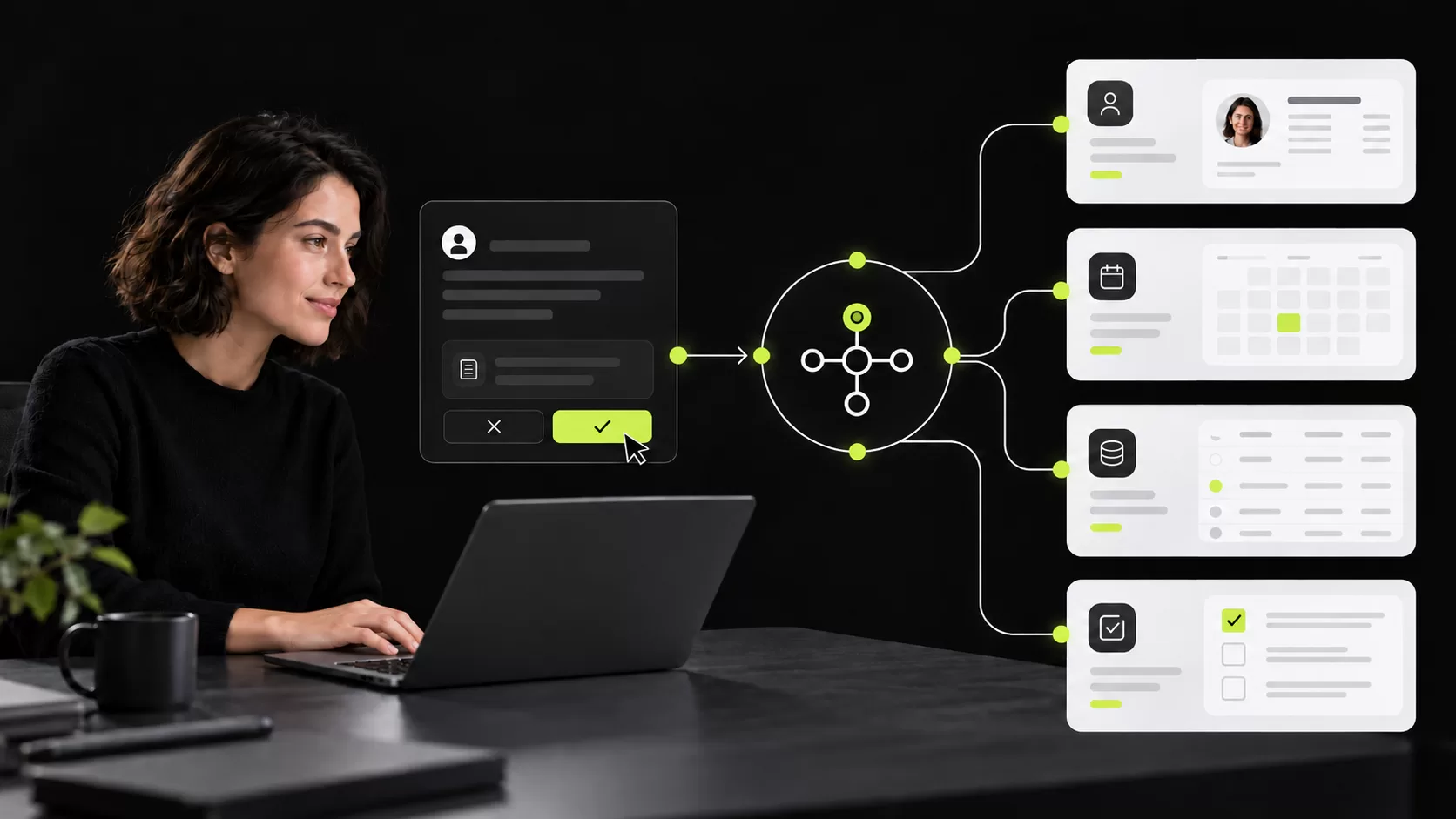
Artificial intelligence assistants can write, analyze, and reason, but their business value grows when they can also retrieve current information and perform authorized actions. Model Context Protocol (MCP) is an open standard that connects AI applications with external data sources, tools, and systems through a shared interface.
In practical terms, MCP helps an assistant move beyond isolated conversations and collaborate with a company's real environment: checking a catalog, finding customer information, reviewing tasks, creating content, updating a process, or triggering an automation within defined permissions.
What is Model Context Protocol?
Model Context Protocol standardizes communication between an AI application and servers that provide context or capabilities. It works like a universal connector: instead of building a separate integration for every model and system, teams use a consistent way to discover tools, send requests, and receive results.
The architecture includes three main participants:
- Host: the application where the user works, such as an assistant, development tool, or business interface.
- MCP client: the component that maintains the connection and coordinates communication with a specific server.
- MCP server: the service that exposes data, guidance, or actions to the artificial intelligence system.
A server can provide resources for context, reusable prompts, and executable tools. The model does not need to understand every underlying API; it works with structured, declared capabilities.
Why does MCP matter to a business?
Many organizations already possess valuable information, but it is scattered across CRMs, spreadsheets, support platforms, calendars, databases, administrative systems, and internal tools. The problem is often not a lack of data, but the difficulty of accessing it at the right moment and turning it into a useful action.
MCP creates a connection layer between artificial intelligence and those systems. This can enable teams to:
- Retrieve authorized data without manually copying information.
- Create or update records from a conversation.
- Coordinate tasks across different applications.
- Generate reports using current information.
- Allow an agent to execute company-defined processes.
- Reuse an integration across compatible MCP clients.
An example: from a conversation to a complete operation
Imagine a customer sending a WhatsApp message to request an appointment. An MCP-connected agent could check available times, validate service rules, register the prospect, reserve a slot, create a follow-up task, and make the conversation history available to the human team.
The conversation is only the visible interface. Behind it is a coordinated sequence of tools and systems. This is one of MCP's most important advantages: AI can participate in real operational workflows without turning every connection into an entirely separate integration project.
MCP does not replace integration strategy
Adopting a standard does not remove the need for good process design. Before connecting an agent, the company should define what information it may retrieve, what actions it may perform, when approval is required, and which situations must be escalated to a person.
Security controls also matter. MCP servers may expose sensitive data or important functions, so implementations should use authentication, least-privilege permissions, input validation, activity logs, and human confirmation for sensitive operations.
The right question is not only “Which tools can the AI use?” but “Which tools does it need to complete this process safely, verifiably, and usefully?”
How Ainoa connects MCP with business solutions
At Ainoa, we design solutions where artificial intelligence integrates with each organization's real operations. Our Custom Intelligent Agents can communicate, retrieve information, and perform actions according to specific business rules.
When the challenge involves centralizing processes, statuses, documents, owners, and metrics, our Custom Administrators provide an operational foundation adapted to the company. MCP can serve as the connection layer that lets assistants and agents interact with those capabilities without relying on improvised integrations.
This approach supports solutions such as:
- Sales agents connected to inventory, customer records, and calendars.
- Internal assistants that consult procedures and create tasks.
- Recruitment workflows that organize candidates and interviews.
- Administrative automations that consolidate data and reports.
- Support agents that retrieve context and escalate exceptions.
How to start using MCP in your company
- Choose one specific process. Look for a frequent, measurable task with clear rules.
- Identify the systems involved. Define where the data lives and where actions must be recorded.
- Set permissions. Separate read-only queries from operations that modify information.
- Design exception paths. Decide when a person must intervene.
- Measure the outcome. Compare time, errors, conversions, or operational effort before and after implementation.
To understand the role the agent plays within this architecture, read our guide explaining what an AI agent is and how it can help a business.
Conclusion
Model Context Protocol (MCP) provides a standardized way to connect artificial intelligence with business tools and data. Its value is not limited to technology; it enables workflows that are more connected, reusable, and controllable.
A useful implementation starts with a real process, clear permissions, and an integration designed around business needs. Would you like to connect AI agents with the systems your company already uses? Talk to Ainoa and let us design a measurable first use case.
From protocol to prototype
To explore the visual experience first, see how Claude Design takes an idea from prototype to a business solution.
Make your connected AI discoverable
Connecting systems is only part of the strategy. Learn why AI search indexing helps businesses appear in ChatGPT, Gemini, Copilot, Perplexity, Claude, and Grok.
Migrate your website and connect an AI agent
If you want to apply MCP to website management, learn how to migrate your website to a block-based system with a connected AI agent while preserving your content and SEO.
From MCP to agents that keep working
The next step is already emerging with Dots, Grok Bot, Muse and persistent AI agents: systems that not only use tools, but retain responsibilities and advance work under human oversight.