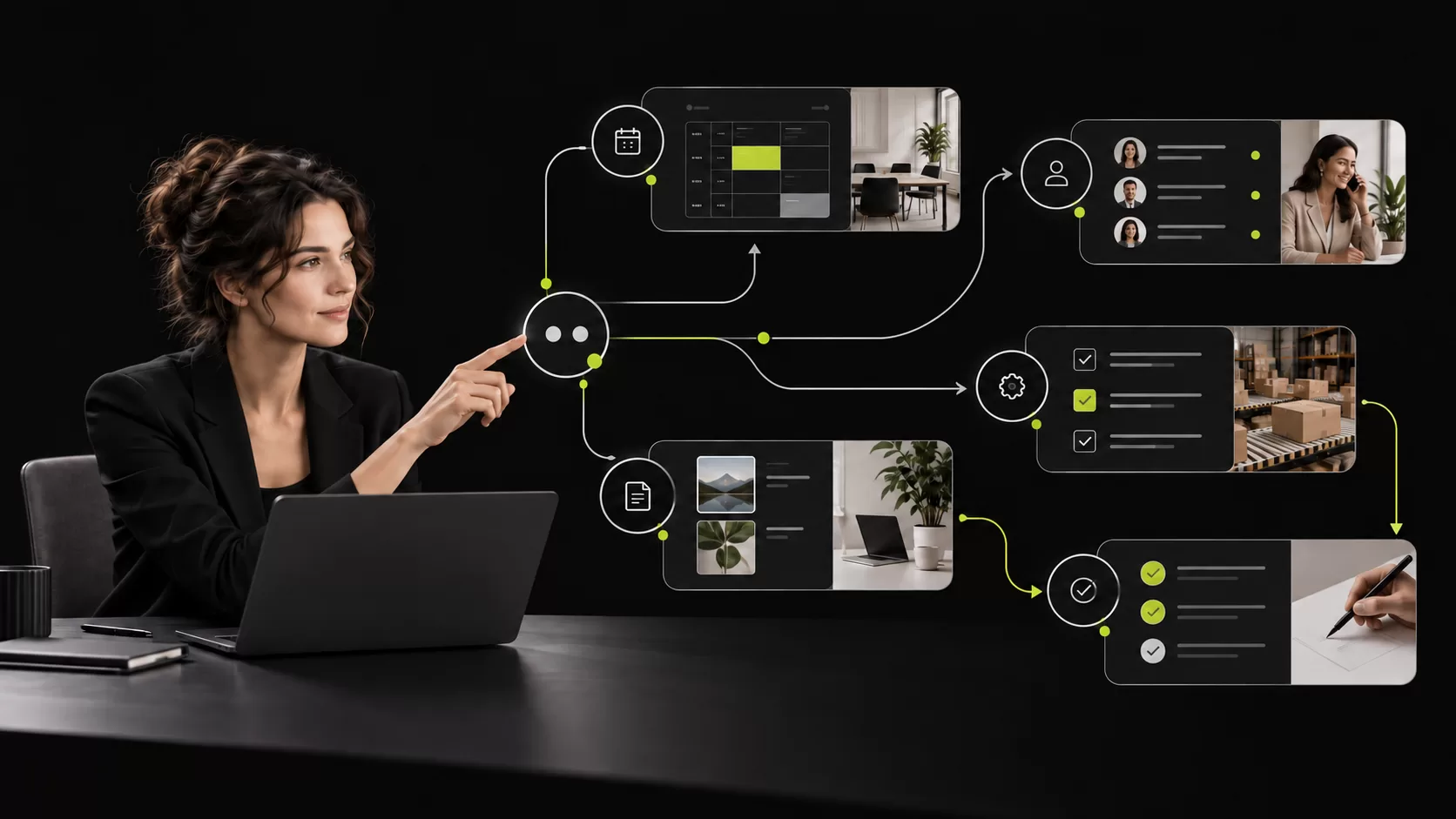
Persistent AI agents are changing the relationship between people and technology: they no longer stop after answering a question. They can retain context, advance goals and return when a decision is needed. ChatGPT Dots, Grok Bot, Meta Muse and Gemini Spark point to a new work paradigm: moving from operating tools to directing systems of work.
The goal is not to think less or hand judgment over to machines. It is to stop spending human attention on copying data, chasing updates and repeating instructions, so people can focus on decisions, creativity, relationships and improvement. At Ainoa, we frame that transition with a deliberately provocative campaign: #NoSeasPrimate. Do not work as if every task must begin from zero and be performed by hand.
What are Dots, and why do they matter?
OpenAI presents Dots as always-on agents inside ChatGPT. A Dot can take ongoing responsibility, work on a cloud computer, connect to authorized applications and expose its progress so a person can review details, provide feedback or approve decisions.
The difference from a traditional chatbot is significant. A chat waits for an instruction, produces a response and stops. A persistent agent retains a goal, organizes tasks and keeps making progress between conversations. Instead of asking only “write this report,” a team can assign a responsibility: “watch these metrics, detect meaningful changes and prepare a recommendation every week.”
ChatGPT Dots, Grok Bot, Muse and Gemini Spark
Different companies are arriving at a similar idea:
- ChatGPT Dots: always-on agents that work with connected apps, contextual memory and human controls.
- Grok Bot: xAI describes a persistent agent with its own computer, browser, files and terminal. Its interface aims to show meaningful progress instead of hiding work behind three animated dots.
- Meta Muse: runs in a dedicated virtual machine, can act across applications and continues working after the person closes the app.
- Gemini Spark: Google describes a 24/7 cloud agent integrated with Workspace tools and able to advance tasks in the background.
These products are not interchangeable, and their permissions, availability and controls differ. Yet they all signal the same direction: artificial intelligence is moving from a conversation window to an operational layer.
The new paradigm: direct work instead of performing every click
For years, digitization often meant transferring a manual task to a screen. A form replaced paper, but someone still copied the information. A CRM organized customers, but someone still chased every update. A dashboard displayed tasks, but someone still moved every card.
Agents make it possible to redesign the process itself. The person defines the outcome, rules, boundaries and approval points. The agent gathers information, uses tools and proposes or executes the next steps. Human work shifts toward five higher-value responsibilities:
- Define outcomes: explain what matters and how success is measured.
- Design boundaries: decide what the agent may do and what requires approval.
- Provide context: connect policies, data and business knowledge.
- Handle exceptions: intervene when the situation requires judgment.
- Improve the system: turn lessons into better rules and automations.
#NoSeasPrimate: automation does not mean stopping thought
#NoSeasPrimate is an invitation to challenge mechanical work. If a person downloads a file, copies a row, opens another application, pastes the data and repeats the process fifty times, their intelligence is trapped inside a routine that automation can handle.
The message is not to surrender control blindly. An agent without clear permissions, reliable data and supervision can multiply mistakes. The new discipline combines autonomy with traceability: least-privilege access, confirmation for sensitive actions, activity records and clear paths for human escalation.
How to bring this paradigm into a real business
The opportunity does not begin with buying the newest agent. It begins by identifying a repetitive responsibility with available data, understandable rules and a measurable result.
- Qualify prospects and organize sales follow-up.
- Check availability and coordinate appointments.
- Classify candidates and prepare interviews.
- Consolidate operational information and generate alerts.
- Maintain content, catalogs and documentation.
- Detect exceptions and route them to the right person.
Ainoa’s Custom Intelligent Agents are designed around these responsibilities: they communicate, retrieve information and perform actions within business rules. When the process must centralize statuses, owners, documents and metrics, Custom Administrators provide the operational foundation on which the agent works.
Together, they create something more useful than a chatbot: a system in which AI understands context, acts through real tools and leaves evidence of what it did. Technologies such as Model Context Protocol (MCP) help connect agents with data and services through controlled interfaces.
A practical way to begin
- Choose a small but frequent workflow. Do not begin with “automate the whole company.”
- Document the expected result. Include normal cases, exceptions and success criteria.
- Connect only what is necessary. Limit data, tools and permissions.
- Start with human approval. Observe decisions before increasing autonomy.
- Measure and improve. Track time saved, quality, errors and opportunities detected.
The advantage will not be owning an agent, but knowing how to direct one
When everyone has access to capable agents, competitive advantage will not come from opening an account. It will come from turning business knowledge into goals, rules, integrations and improvement cycles. Organizations that learn to delegate responsibilities with control will respond faster without giving up judgment.
Dots, Grok Bot, Muse and Gemini Spark are visible signals of this shift. The question for a company is no longer whether AI can answer. It is which part of the work should still wait for a person to click.
Frequently asked questions
Does a persistent agent work without supervision?
It can advance autonomously within defined boundaries, but sensitive actions should include permissions, approvals and activity records.
Do I need to replace all my systems?
Not necessarily. An agent can connect gradually to existing tools through APIs, MCP and purpose-built automations.
Where should a small business start?
Start with a frequent and measurable repetitive task, such as sales follow-up, scheduling, information consolidation or content maintenance.
Take the first step
If you want to identify which responsibilities an agent could take on inside your operation, talk to Ainoa. We design bounded, measurable automation connected to the way your team actually works. #NoSeasPrimate: direct the system; do not repeat the process.